Opening days and times are subject to notice (by calling no. 5155365)
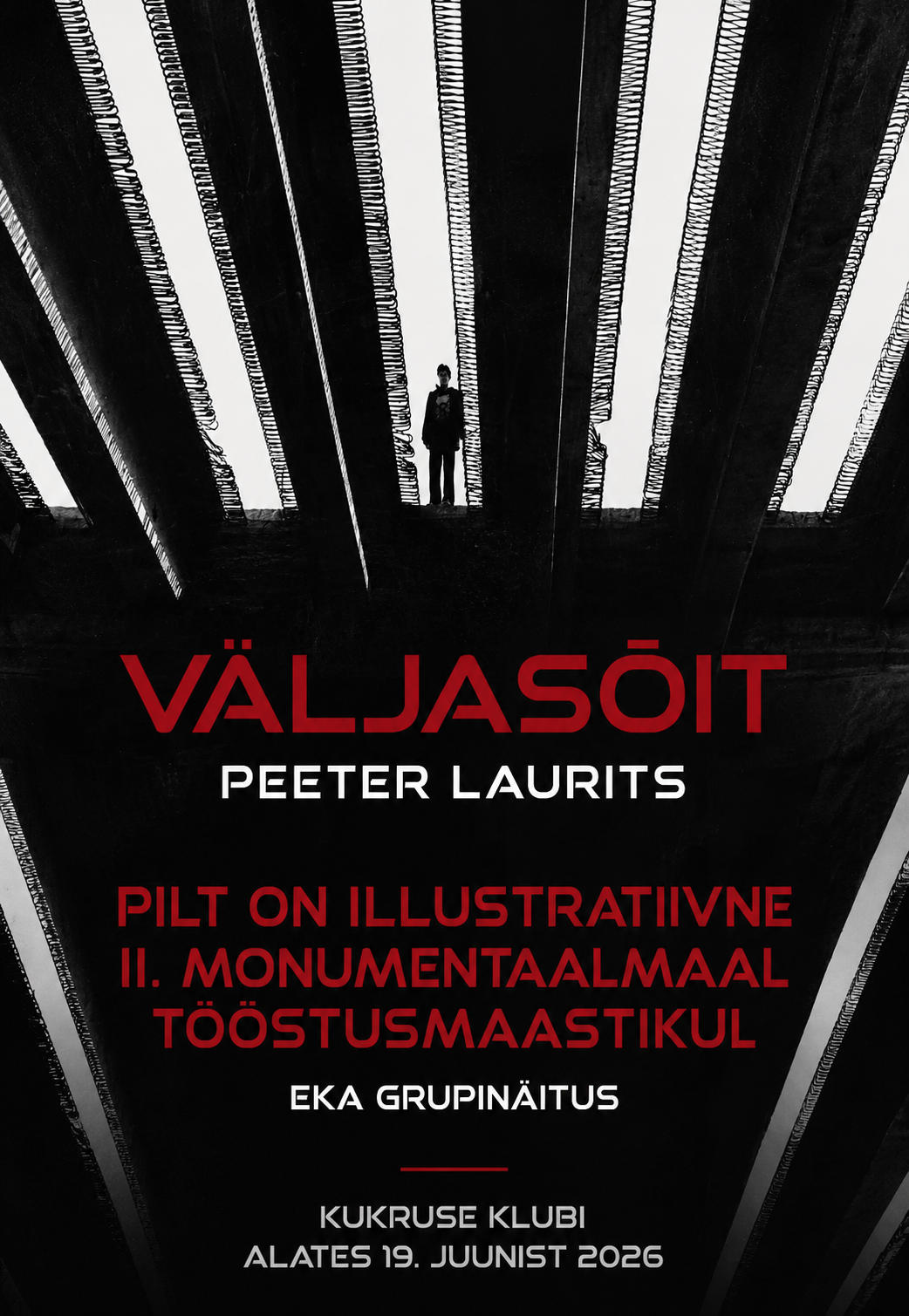
 All culture lovers, both residents of Kohtlajärvi and those interested from further afield, are invited to the former Kukruse Club (Lehe tn 10a, Kukruse) on June 19 at 7:00 p.m. to discover the program of the "Stalker" museum in Ida-Virumaa: the exhibition project "Excursion".
 Kukruse is the place from where the first test mine in Estonia was established in 1916 and 22 wagonloads of oil shale were sent to the then Petrograd. Even now, more than a century later, millions of tons of oil shale are still mined annually in Estonia. However, not anymore in Kukrus. Underground human activity has been silent here for almost 60 years, and the Kukruse Club has stood largely empty this century.
"Väljasøit" partially continues the exhibition "Pilt is illustrative", which was completed in the spring in the EKA Gallery and was created in cooperation between EKA and TU, the subtitle of which is "Monumental painting in an industrial landscape" in Kukrus. The exhibition discusses the legacy of totalitarian regimes and questions of the need for intervention. A part of Peeter Laurits's photo series "Väljasūt" will be shown at Kukrus Klub, in which in the emerging hyperspace the supremacy of man has lost its validity and other forms of life earn respect. According to the artist, in order to create such a space, it is necessary to imagine "a situation where human data networks (with all network robots, semi-intelligent functions and deep learning) and natural networks (with all mycorrhizae and bird migration patterns) find a contact surface, start communicating with each other and finally grow together".
The works of another photo artist, the photo legend of Ida-Virumaa Juhan Lasman, tie the exhibition into a cultural-historical whole. In addition to Lasman's black and white industrial landscapes, his photos shine through with a sharp social sensitivity and the depiction of everyday life during the heyday of oil shale mining. The evening will end with Godfrey Reggio's cult documentary "Koyaanisqatsi", which already in 1983 talked about our planet as a place where the balance between nature and technology has gone out of control.
 Participating artists are Peeter Laurits, Arne Maasik, Juhan Lasman, Raoul Kurvitz, Ernst Hallop, Richard Sagrits, Viktor Karrus, Hanna Piksarv, Kati Saarits, Anna Škodenko, Sigrid Viir and Jevgeni Zolotko.
 The "Stalker" museum is part of the TSOON project, which in this decade has implemented a series of different cultural mini-events in Northern and Eastern Estonia, which deal with the points of contact of industrial heritage, local folklore and contemporary art through intermediate use methods, including creating opportunities for the interesting and dignified exhibition of large-scale Estonian art. The name of the project is inspired by Strugatski's science fiction novel "A Trip to the Green", which takes place mostly in an environment called TSOON. It is in these zones that the aliens who have visited Earth in the novel have left behind strange - and valuable - artifacts. Isn't this also a socio-political metaphor for the consequences of past times and powers, which in fiction can take the form of a golden ball, but in Kukrus it manifests as an entire building? We still call this mineral zone the land of brown gold.
 The exhibition "Excursion" is held in cooperation with the Estonian Academy of Arts, the Kohtla-Järve City Government, the Kohtla-Järve Oil Shale Museum and the Foundation for Righteous Transition. The project is supported by the Estonian Cultural Foundation. The event is free and part of the 80th birthday program of the city of Kohtla-Järve.